Christmas in a Cloak and Dagger

ByAlexander Soldatov
Jan 11, 2026
Almost four years have passed since the beginning of the Special Military Operation, and it would seem that Patriarch Kirill has presented every possible argument in support of "holy warfare" and even "canonized" the Russian Armed Forces soldiers who died on the front as martyrs. However, in his Christmas interview, published on January 7, the head of the Russian Orthodox Church managed to find new arguments, one of which sounded particularly ominous. The Patriarch effectively called for the repression of "traitors to the Motherland," pointing to state security as the most important value of our nation.
Instead of Christmas
Overall, this interview raises more questions than it answers. The patriarch explains the "tension" between Russia and the West by saying that today's Russian Federation represents "a very attractive alternative for civilizational development." The source of this "attraction" is the Christian faith and the proclamation of religion as a public, state matter, not a personal one.
There's no need to even look at the Russian Constitution or laws, which proclaim a completely opposite approach to religious freedom. Just look at the statistics on church attendance in Russia on Christmas Day. In recent years, this figure has not exceeded 1-2% of the country's population, meaning it's within the margin of statistical error. It pales in comparison to similar figures in most Western countries—for example, Poland, Spain, Italy, and the United States.
According to Kirill, the Russian state promotes the Christian faith. Russian Muslims are unlikely to readily agree with this thesis (incidentally, attendance at Moscow mosques on major holidays traditionally exceeds the total attendance at Moscow churches). In a society as multi-ethnic and multi-confessional as Russia's, promoting ideas about the dominance and special status of any one religion is extremely short-sighted.
Continuing his denunciation of the West, Kirill declares that its "civilization condones sin." But what kind of sin? Even in the realm of basic family morality, there are numerous discrepancies between Orthodox Christians and Muslims: polygamy, while sanctioned by the Quran, is considered a sin in Christianity...
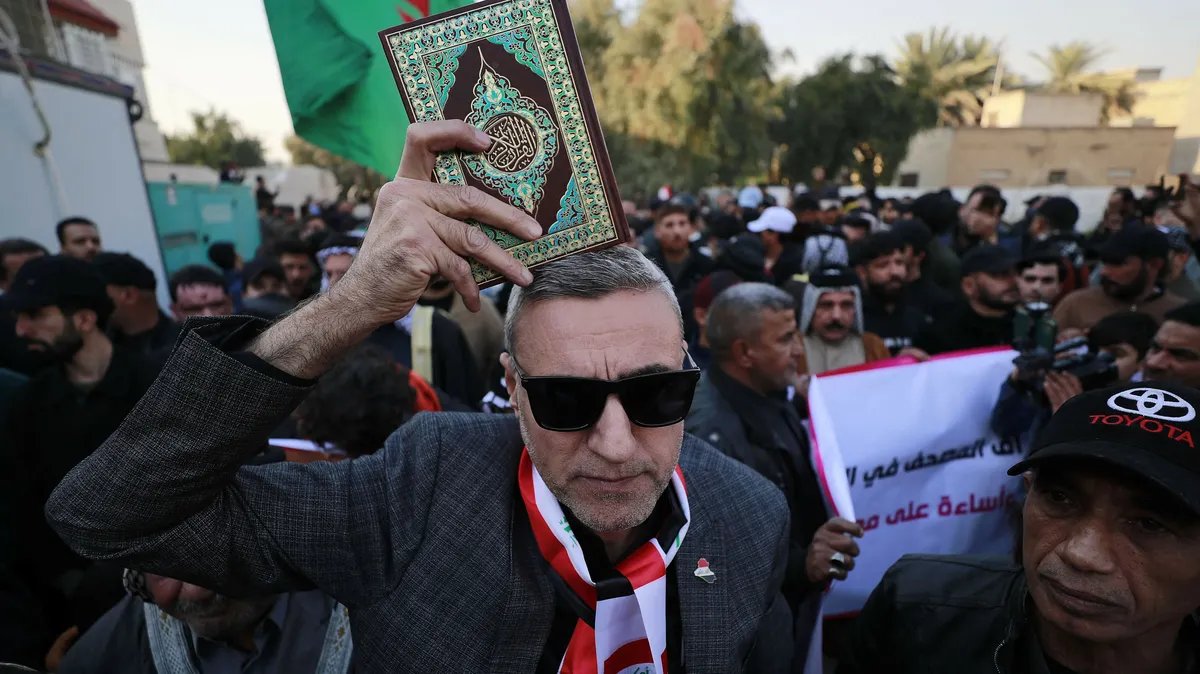
The Russian Orthodox Church claims that Orthodoxy is closer to Islam than to Western Christianity. This is a new development in the history of religion and a distinct political trend.
Finally, the head of the Russian Orthodox Church proclaims military action as a guarantor of public morality: "What is happening today is a remarkable indicator that moral feeling remains in the hearts of our people." In this perspective, sacrifice is a key concept for Kirill: "To give one's only life for the highest goals—for society and the state... Love for the Fatherland is always linked to sacrifice." Amid the patriarchal fervor, security at the Cathedral of Christ the Savior was significantly increased this Christmas: for the first time, security forces with automatic weapons and/or anti-drone guns were spotted at its doors.
But even within the framework of "SVO (Special Military Operation) theology," a patriarchal appeal unexpectedly resounded, one more fitting of a cloak-and-dagger knight than a monk or pastor. "There are concepts that are linked to the very capacity and possibility of a state's existence," he said. "There must be a public consensus around these concepts. If someone falls outside this consensus, then there is the definition: a traitor to the Motherland, with all the ensuing legal consequences." And, again avoiding specifics, the head of the Russian Orthodox Church merely hinted: "There must be consensus around the most fundamental issues of our security," which are obviously being addressed by the competent agencies. "If there had been consensus," Kirill concluded with a nostalgic sigh, "the Soviet Union would not have collapsed."
The call for punishment "with all the ensuing consequences" reeks of 1937. Especially given the complete uncertainty about who exactly defines the essence of "social consensus," what the criteria are, and how disagreement with it is expressed...
From the context of the interview, one thing can be understood: the core of the “consensus” is the SVO and confrontation with the West.
Kirill's ideal, with his nostalgia for the USSR, seems to be a totalitarian society led by a leader who is the primary source of the moral code. It's no wonder the head of the Russian Orthodox Church, even when formulating his doctrinal theses, likes to cite Putin: "Our president <…> answered journalists' questions about Orthodoxy's relationship to Catholicism and Islam: 'We are closer to Islam.' I think so too." Kirill emphasized his messianic status both at the World Russian People's Council (WRPC) in 2023 and, especially, at the prayer service on the day of the presidential inauguration in 2024, predicting Putin's rule until "the end of the century," that is, until Armageddon. Incidentally, Putin's apocalyptic prophecy, "We, as martyrs, will go to heaven, and they will simply die," has become a meme and has successfully spread among the people.

Uniformity of faith no longer stops conflicts between states, and regimes simply need an institution that sacralizes death for the homeland and the leader
Saints, imaginary and real
The simplest test of the Christian identity of Kirill's teaching is the question: "Was Jesus Christ a patriot? Did He share the 'social consensus' of His state?"
If we understand that Jesus' earthly life began with forced exile (Matt. 2:13-15) and that He was executed on political charges (John 19:12), the answer is obvious. Christ contrasted his earthly homeland with his heavenly one, saying that His kingdom was "not of this world" (John 18:36), and called the political leaders of His people children of the devil (John 8:44). Following the Teacher, the apostles also did not display patriotic feelings, reminding everyone that "our homeland is in heaven" (Phil. 3:20).
Archpriest Andrei Kordochkin* dedicated his book, "Render unto Caesar the things that are Caesar's. Should a Christian be a Patriot?" to the complex history of the relationship between Christianity and patriotism. Speaking about the bright side of love for one's homeland, Father Andrei believes it is important to separate these feelings from political loyalty and servility to the authorities. "It cannot be," he notes, "that a single political force rules the country forever. If the government changes, if the perception of the country's interests changes, what should a patriot do? Should he follow what the new government proclaims as its interests? Then he's probably not really a patriot, but rather an opportunist." Father Andrei warns of the dangers of patriotism for "a person who lacks a clear understanding of good and evil."
As the patriarch's teachings demonstrate, patriotism and state security in modern Russia are reduced to support for the SVO and loyalty to Putin. Within this framework, church dogma is transformed: "If everything that happens is declared a 'holy war,' then all who die in it are saints... The cult of martyrs—religious or civil—forms a community, a new collective identity of people united by their veneration," says Father Andrei. From such a cult, it's only a step to mass repression: "Through the cult of martyrs, cleansing society of 'traitors' becomes an easier task; indeed, it becomes a sacred duty." The martyrs of the classical period of Christian history are a completely different story! According to current Orthodox patriotic notions, they, like Christ, were lawfully repressed—for "treason."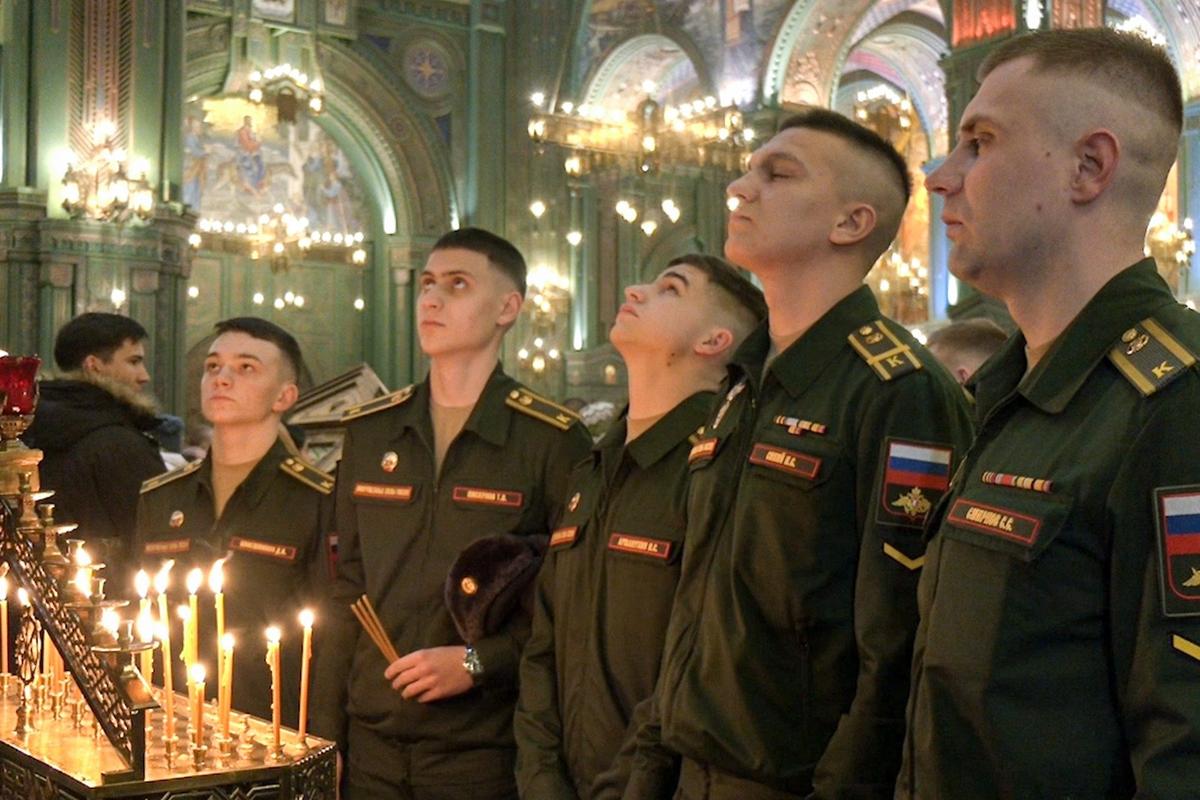
Christmas celebrations in the Moscow region. Photo: Russian Ministry of Defense Press Service / TASS
Let us recall the holy martyr Maximilian of Thebes, who was executed at the age of 18 in the late 3rd century by order of the Roman Emperor Diocletian. Under wartime conditions, the martyr refused to take the oath of allegiance to the imperial army, to which he was legally called. By accepting his life, the church also recognized the teaching Maximilian preached before his execution: "It is not fitting for a Christian, fighting for Christ his Lord, to fight for the army of this world. I am not permitted to serve, for I am a Christian." And this is far from an isolated case. The authoritative church teacher Tertullian (155–240) wrote: "God's oath is incompatible with man's, the sign of Christ with the sign of the devil, the army of light with the army of darkness." Church councils of the first centuries of Christianity excommunicated Christians who went into military service from communion, and in the Byzantine era, a three-year penance was established for them in the event of returning from war.
The merger of the Christian Church with the Roman (and, to a greater extent, the Byzantine) state led to the gradual infiltration of pagan principles, including state worship, unknown to early Christianity, into the Church. This led to a radical reinterpretation of the most basic commandments, which—in the interests of power—were sometimes interpreted in a manner directly opposed to their original meaning (Novaya Gazeta examined this phenomenon using the example of the commandment "Thou shalt not kill").
But even in the era of state Orthodoxy, saints were venerated not only by tsars, princes, and their faithful servants, but also by ascetics who dared to invoke the Gospel, denouncing the crimes of earthly rulers. At the very end of the 4th century, John Chrysostom, highly revered by the Orthodox (whose liturgy is celebrated almost daily), was sentenced to death for criticizing Empress Eudoxia. Only a terrible earthquake and the empress's sudden illness led to a reversal of the sentence.
Russian church tradition attributes responsibility to Ivan the Terrible for the executions of the then primate of the Russian Orthodox Church, Metropolitan Philip (Kolychev), Archbishop Herman of Kazan, who was killed by oprichniks, and Abbot Cornelius of Pskov-Pechersk, whom the tsar killed with his own staff.
Almost all the new martyrs of the 20th century who were executed by Soviet punitive organs were accused of anti-Soviet activity, that is, of violating that very “social consensus” and of “treason.”
Patriarch Sergius (Stragorodsky), who later concluded a concordat with Stalin and laid the foundation for the modern Moscow Patriarchate, was suspected by the NKVD of spying for Japan in the late 1930s.
How does all this relate to Kirillov’s discussions of the “consensus,” the violation of which led to the tragic collapse of the USSR?
In truth, this worldview has no solid foundation. It's nothing more than conformism, which has supplanted true patriotism, which encourages concern for one's country's tragedy and calls for warning about the mistakes, and especially the crimes, of the authorities. This particular brand of ecclesiastical opportunism, which gave rise to the bizarre alliance between the Russian Orthodox Church, the atheistic authorities, and the KGB, has gone down in history as "Sergianism," named after Stalin's first patriarch. Back then, the Russian Orthodox Church called Stalin a "God-given" and even "God-appointed" leader, while today it recognizes Putin as a messianic leader, blessing him to rule until the end of time and refusing to entertain the idea that he could make any mistakes.
This isn't even a heresy, but the very same "religion of human-worship" that Father Sergius Bulgakov discerned in Marxism. It never left Russian soil after the fall of the USSR, but merely took on the garb of "traditional faiths."
Putin's Theology
Since the highest authority (or, as stated in the “Spiritual Regulations” of 1721, “the ultimate judge”) of the church institution is the head of the Russian state, then one has to listen to his rare but apt statements on theological topics.
The surprise from Putin's teaching about the "unknowing" God, voiced during the direct line on December 19th ("The Lord... does not know that people on earth have divided into some kind of churches") had not yet passed, when a new revelation followed.
Vladimir Putin at a Christmas service in the Moscow region. Photo: Vyacheslav Prokofiev / Press Service of the President of the Russian Federation / TASS
After the Christmas service, which Putin attended at a closed-to-the-public church in a military base near Moscow, the president delivered a sermon of sorts, standing in the middle of the church. "We," he said, "very often call the Lord our Savior, because He once came to earth to save all people." What does the SVO have to do with this, one might ask? The fact is, service members of the Russian Armed Forces are modern-day Saviors. Not somewhere far away and long ago, not in Israel thousands of years ago. But here and now: "By the Lord's command, they fulfill this very mission—to defend the Fatherland, to save the Motherland and its people. And at all times, Russia has treated its soldiers in this way."
Now the patriarch will have to confront the court theologians with a difficult dialectical task: explain how Jesus, who did not take up arms and forbade his disciples to do so (John 18:11), fulfilled the mission of soldiers. Or vice versa.
*Recognized as a “foreign agent” by the Russian Ministry of Justice.
Source: Novaya Gazeta https://novayagazeta.ru/articles/2026/01/10/rozhdestvo-v-plashche-is-kinzhalom