At the royal court
 |
| Reverend Vandregizil |
Vandregisil was still a young man when his parents decided to marry him. Obedient to his parents' wishes, he became engaged to a girl from a good family, whose ancestors were quite distinguished. This was one of the most distinguished families. But Vandregisil was deeply troubled. He longed to leave the world and serve only the Lord, but he feared that his fiancée, even knowing this, would not consent to the dissolution of their engagement. Therefore, Vandregisil decided to marry her first and only then discuss monastic life. And so, having contracted the marriage union with this girl, he, thinking of her welfare and fulfilling the Gospel commandment to love thy neighbor as thyself (see Matthew 19:19), began diligently explaining to her the teachings of the Church, which he knew very well. He especially emphasized the great reward that awaits those who, being one flesh on earth (cf. Matthew 19:5), lead a virtuous life in a monastic manner, desiring unity in heavenly glory with the saints in Paradise. And one day, enlightened by the Holy Spirit, she interrupted him and cried out: “O my lord! Who hindered you from telling me this sooner? I assure you that I will unhesitatingly dedicate myself to the service of the Lord, leaving behind the vanity of this world to labor for the acquisition of the glorious Kingdom of Christ. I have only one request of you, my lord! And this is it: may this intention be fulfilled as soon as possible—to subject us both, you and me, your faithful spouse, to the glorious yoke of Christ.” Hearing this, Vandregizil was filled with joy and thanked the Lord for the greatness of this calling. And so, by mutual consent, they decided to part. Vandregisil himself performed the tonsure [6] and placed the crown of glory on the head of his spouse. And we mention here that the purity of her life and heart was such that the Lord, even during her lifetime, rewarded her with the gift of performing numerous miracles [7] .
Now, looking back, let's return to the time when Vandregisil first experienced the power of God—it happened when he was still a layman. Once, while traveling, Vandregisil, accompanied by his wife and a large retinue, stopped for the night in a place inhabited by people so unkind and dark-hearted that they feared neither God nor their master. A dispute over pasture for horses nearly led to a fierce fight, and many casualties could not have been avoided if not for the divine righteousness and virtue of the man of God. Needing protection, the most effective, the saint armed himself with prayer to God instead of a sword and protected himself with His mercy instead of a shield. The Lord, who loves to respond to the prayers of His faithful servants, came to the rescue—and the quarrel suddenly ceased. The adversaries came to an agreement and became friends. Thus, the son of peace became an instrument in God's hands for reconciling rivals. This event further increased Vandregizil's zeal, and he henceforth loved to repeat these words: "Is He not worthy of being loved more than anything else in the world - Him, God, Who immediately appears where they sincerely call upon Him, as He promised: "When you seek Me with all your heart, you will find Me"?"
Montfaucon
The man of God, having decided to leave the ease of this world, began to search for a monastery in which he could lead a life equal to that of the angels. For a brief period, he labored with a certain man, already advanced in years, in a place called Montfaucon [8] . Our ascetic was then still a young man, of a most elegant appearance, with luxuriant hair, eyes blazing with a living fire, a face whiter than a lily, and long, slender hands, which he cared for with great care. He gave away all his possessions and began to live in poverty. But the devil, who loves to cause harm and to combat goodness, resorting to all manner of tricks, became inflamed with great envy of Saint Vandregizil and from then on constantly attacked him—either himself or through wicked people. But Vandregizil, having on his head the helmet of salvation, according to the words of the apostle, and protected by the shield of faith (see: Eph. 6:16-17), resisted the attacks of his enemy, emerging victorious from these battles.
King Dagobert—who reigned at the time, and whom Vandregizil had served faithfully since his youth—could not allow the saint to take monastic vows without his permission, and so he summoned the ascetic to his palace. The man of God, placing all his hope in Christ, whose help was swift to come at the right time, reluctantly set out for court. Approaching the palace, Vandregizil noticed a poor man whose cart had become stuck in the mud right in front of the entrance. Passersby not only did not stop to help the poor man, but, on the contrary, pushed and nearly trampled him. Arriving at the scene and seeing the cruelty of these hard-hearted unfortunates, Vandregizil, the man of God, dismounted from his horse and approached the poor man, eager to help him. He succeeded in pulling both the man and his cart out of the mud. Onlookers, seeing how dirty he was, began to laugh loudly and hurl insulting words at him. He, however, paid no attention whatsoever, humbly following his Master—the model of humility—for, "If they have called the master of the house Beelzebub, how much more will they call his household?" (Matthew 10:25). And since he accepted this insult for the glory of God, an angel immediately appeared and completely cleansed his garments. And in this attire, even more beautiful than before, Vandregizil entered the royal palace and, like a lamb before wolves, stood before the king and his court. The Lord, the Good Shepherd and Protector of all saints, preserved Vandregizil and snatched this lamb from the jaws of his enemies; they all unanimously recognized that he was truly a man of God and that only the desire to serve Christ had prompted him to no longer seek the glory of this world. The king ordered that the saint should no longer be disturbed, and declared that he was henceforth free to devote himself to the contemplation of the Divine Glory.
Saint-Ursanne
Upon returning from the king, Vandregisil, using his own funds, established a small monastery in a different location [9] . Here he devoted himself to fasting and vigil. The ascetic spent his days in prayer, accompanied by heartfelt contrition and tears, and when he could no longer remain awake, he prostrated his emaciated body right on the bare ground. He imprisoned himself in this prison—both out of fear of Gehenna and out of love for Christ. Meanwhile, the devil, seeing how the ascetic was progressing in his spiritual life, began to mercilessly attack the saint—and the evil one inflicted countless torments day and night.
Trying to tempt the saint, the unclean spirit suggested to him the idea of weakening his ascetic efforts; but the servant of God, understanding the full cunning of the enemy, overcame the temptations with the sign of the cross and abstinence.
The devil, seeing himself vanquished, attacked the saint with even greater cruelty when he, yielding to the needs of human nature, fell asleep. The enemy then plotted against him, sending him dreams. But, upon awakening, the man of God immediately asked for God's intercession, crying out: "O Lord, in Your righteousness deliver me and set me free; incline Your ear to me and save me" (Psalm 70:2), and he prayed for the strength to drive away the treacherous adversary. If, however, dreams came to him in his sleep, the saint, immediately waking, went to the river and immersed himself in its waters, weeping and lamenting. There, even in the depths of winter, the saint would usually read the entire Psalter, standing amid the icy streams and immersing himself in the water at the end of each psalm [10] . What labors, what daily battles with the enemy! And the merciful Lord, knowing that all the ascetic's thoughts were directed toward Him, came to Vandregisil's aid, and this blessed man, who spiritually bathed His holy feet with tears and wiped them with the hair of his head (cf. Luke 7:38), through strict abstinences that sometimes lasted for weeks, vanquished the enemy arrayed against him.
Bobbio
Seeing Vandregisil's tenacity in spiritual warfare, the Lord sent him a messenger to console him. One night, as usual, the saint was sleeping on a mat in his hut. An angel transported his spirit to the monastery of Bobbio, in the land of the Lombards, also called Italy [11] , and Vandregisil saw both the monastery's surroundings and its buildings. When the angel departed from him, the saint wanted to know the name of the monastery. Then he recalled the words of the Gospel: "Whoever among you does not renounce all that he has cannot be My disciple" (Luke 14:33) and "If anyone desires to come after Me, let him deny himself, and take up his cross, and follow Me" (Luke 9:23), and the saint decided to follow these commandments. And so Vandregisil cast everything aside, and taking with him only three young servants and a donkey, he set out as an unknown wanderer from his land, his family, and his father's house (see Gen. 12:1), not even knowing which way to go. But the Lord, through an angel, showed him the right path.
Thus he arrived at the monastery he had seen in his dream, and without difficulty immediately recognized the very same monastery to which he had been led by divine power in the vision. He remained there for some time. It was clear to the monks of the monastery that Vandregizil was truly a warrior of Christ, following the path of salvation, and soon they learned of his noble origins. The Lord often revealed secret events to him; however, Vandregizil himself always strove to remain in the shadows, concealing his virtues and pleasing only God, for he kept in mind the words spoken by the Savior to the Pharisees, those false servants: "You pronounce yourselves righteous before men, but God knows your hearts" (Luke 16:15). He locked away those wondrous works of God in the secret place of his heart and sought only to please the One whose eyes looked upon him from heaven every day. Desiring to live in an even more solitary place and to go through the strait gate and the narrow way (Matt. 7:14), Vandregizil decided to go to Ireland, moved by ardent divine love, for the love of Christ was poured out in his heart by the Holy Spirit given to him (cf. Rom. 5:5).
Romainmôtier
 |
| Reverend Vandregizil |
Desiring to attain high holiness, Vandregisil, leading a humble life, shunned vanity, loved meekness, and was constantly vigilant lest the devil, through his pride, interfere with the good deeds he performed. The ascetic strove to never violate the monastic rule, avoided verbosity, and above all, loud laughter, remembering the words of Holy Scripture: "A fool lifteth up his voice in laughter" (Sirach 21:23), and was always ready to faithfully and joyfully fulfill God's commandments. These virtues became, as it were, a second nature to the saint. In particular, they saw in him a humility unmatched by any other of the brethren. I have already spoken of his prudent speech; I will also speak of his ever-welcoming face, expressing kindness and love, and of his prudent patience. Vandregizil not only never spoke anything evil of others, but he also did not wish to hear anything of the sort. He never complained, but was obedient, and he accepted everything that came from the abbot's lips as a command given by the Lord. He feared to deviate from God's commandments even in the slightest, and his thoughts were always directed toward Him. No matter what obedience he performed, he always recalled the word of God and meditated on it. Zealous in ascetic deeds, Vandregizil exhausted his flesh, through which he was connected to this world. Having rejected everything, he bore his cross. Dead to the world, he lived only for God. And the Lord, seeing such zeal in serving Him, rewarded Vandregizil with many gifts: clairvoyance—so that a single glance was enough for him to discern the aspirations of people's hearts; and with the gracious ability to awaken souls that seemed to be sleeping in indifference and spiritual laziness, he resurrected them to labor for the sake of faith.
I cannot help but recount a great miracle, recounted to me by Vandregisil himself. One night, while the saint was deep in prayer in his closet, an angel appeared to him in a blaze of blinding light—and immediately the saint's dwelling was filled with a wondrous fragrance. And a voice spoke, saying: "Servant of Christ, who lives in the fear of God, peace be with you! You have found favor in the eyes of God! Persevere in the good deeds you perform to the end, for the Lord has already prepared a crown for you. And the Lord will lead you into the mansions of paradise, where you will forever rejoice with Him." And then the same voice prophesied: "Gond, your nephew [14] , will come to you soon."
Hearing this, the man of God fell prostrate, bursting into tears. And his prayer became even more fervent, for he was not at all arrogant because he had seen and heard an angel praising him. On the contrary, he became even more humble, for he considered himself unworthy, given his sins, of God sending a messenger to him. Blessed is the holiness of the blessed man of God, deemed worthy of praise from the Most High! Blessed is the man who has mortified earthly feelings in order to become a true child of God! Blessed is humility—despised by the people of this world, but precious in the eyes of God. This is the path that Vandregisil walked, and therefore he inherited the Kingdom of Heaven.
Fontenelle
We have now reached the time when the Lord wished to reveal His saint to the world, to show that a precious pearl had been taken from His treasury to lead many to salvation, thereby further adorning his double crown [15] . Vandregizil arrived in the holy city of Rouen, whose episcopal see was then governed by Saint Owen [16] , the defender of Orthodoxy. Owen, immediately recognizing Vandregizil, who was now under his obedience, as a devoted servant of God, wished to ordain him to the rank of subdeacon, although the ascetic resisted. Later, he made him a deacon, and then asked Bishop Omer [17] to ordain Vandregizil to the priesthood. The newly ordained priest, gifted with many gifts, easily fulfilled all his duties.
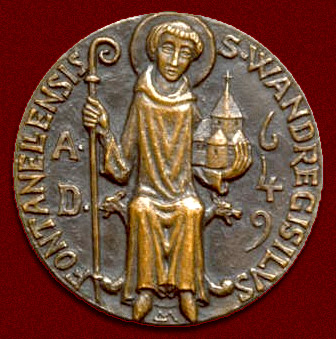
Vandregizil, who never ceased to draw from the inexhaustible source of humility and always wished to remain far from worldly affairs, began to wait for the Lord to indicate the place prepared for him where he could live in obedience to the holy rule. And indeed, the Lord designated for him such a place where this good shepherd could pasture the large flock of Christ. The saint settled near the spring of La Fontenelle, which gushed from the ground, in the forest of Jumièges, on land purchased with money kindly donated by the royal house. Here the saint founded his monastery [18] , building it from spiritual stones - that is, holy souls. Here he erected churches in the name of Saint Peter, Saint Paul and Saint Lawrence; a little further, about a mile from the monastery, he built a chapel in the name of Saint Amand of Rhodes [19] , to whom he often prayed [20] .
Vandregizil's zeal for achieving the perfect life endeared him to Saint Owen, in whose diocese the monastery was located; the ascetic always honored the ordinances of the Church, was exceptionally humble, never acted on his own will, and never went on any journey without the blessing of the bishop [21] , remembering the words from the Gospel: "Whatever you bind on earth will be bound in heaven; and whatever you loose on earth will be loosed in heaven" (Matthew 18:18).
Vandregisil desired neither gifts nor any kind of support for his community to earn their daily bread by anything other than the labor of their own hands. And he maintained this rule for a long time. And the Lord, seeing his zeal to increase the talents with which he had been endowed, sent him many disciples. They, responding to his teachings, abandoned their fathers, mothers, homes, fields, and all that belonged to them. The man of God, seeing how many monks the Lord had sent him, was now forced to abandon the complete poverty of his monastery, but he consented to accept anything only from those who, enlightened by God's grace, decided to take upon themselves the burden of serving the Lord. So now he could satisfy the simplest needs of each of the disciples, giving at least food and clothing, in accordance with the words of the apostle: “Having food and clothing, let us be with these content” (1 Tim. 6: 8) [22] .
As a true shepherd, Vandregizil, obedient to God's commandment, laid down his life for the sheep (see John 10:15); his meekness softened harsh morals; his humility corrected the proud, making them humble again, and his instructions returned many to God. He was like the wise scribe in the Gospel, who brings forth from his treasury things new and old (see Matthew 13:52). He encouraged the fainthearted, consoled the weak, aided the sick, and fought hard against the devil for their sake. He often snatched victims from the jaws of this ferocious lion and, like a good shepherd, returned them to the flock of Christ, healing their wounds with his gracious words. He taught his children how to resist the enemy's attacks and not abandon their calling, telling them these words: "To look back, my son, is to repent of the good work begun and to burden oneself with worldly desires. My dear child, a truly humble man is one who continually strives higher. No one should complacently recount the years spent in a monastery, but each one should ask themselves whether they have lived all this time in love and obedience to God's commandments. And therefore, when we proudly think that we are neither thieves, like some, nor murderers and villains, like others, we must examine our deeds in conscience. Is there anyone we hate? Do we not have an innate fear of slander? And do we allow ourselves to be inflated with pride or overcome by ambition? Have we not defiled ourselves with impure thoughts? Are we not easily angered? Are we preoccupied with vanity? Have we laughed too often? Do we waste time in idle chatter? And do we truly strive with all our might to preserve love, peace, joy, and goodwill? The purpose of our lives is to be ready at any moment to fulfill God's commandments—and then the Lord will rejoice over us and reward us with crowns. The devil, on the other hand, will find himself vanquished, for his greatest sorrow is to see us rushing to fulfill God's commandments. Dear children, be careful that nothing worldly taints yourselves. Today we live, and tomorrow—who knows what may happen to us? Let us not forget that God's mercy has transformed us from sons of darkness into sons of light—so let us cast away every deed of darkness and walk our path in the light of Christ's commandments. "Be vigilant, lest the devil, ever so zealous and envious, ensnare you. Be united in love and serve one another with the fear of God. Then the enemy will flee from you, for he cannot approach those whom he sees as united in spirit: they are firmly bound together by the love of Christ—and those who are inseparable force him to retreat."
The man of God himself constantly battled the devil. But most of all, he was concerned with instructing his disciples, whom he nourished with the word of God as with milk, so that they too might wage war against the devil: he helped them understand the source of his poisonous arrows. And throughout his life, Vandregisil kept the flock of Christ in peace in his monastery, carefully guiding each sheep and never hearing a single word of complaint—so recognized was his superiority over them all. His humility was so sincere that, for the edification of his disciples, the saint continued to toil with his own hands, even when he was already a gray-haired old man.
This renowned warrior of Christ, whose prayerful zeal lifted his heart to heaven, still remained on earth because of his love for his brethren; and he skillfully fulfilled his ministry, so that, like the apostle, he could become all things to all men—he won their souls for Christ. The gracious gifts received by Vandregizil from God moistened the barren pagan soil, sweetened the waters of a once dried-up spring and the waters of the Dead Sea (see Joel 3:18; Ezek. 47:5-10) [23] . The fame of the holy man spread far and wide; even those who had never seen Vandregizil were convinced that they had received God's mercy through his prayers. The influence of his preaching was so great that in a relatively short time the wild and ferocious inhabitants of the surrounding areas were converted to Christ; even robbers left behind their plunder. And as hard as it may be to believe, barbarians, only recently converted to Christianity, prostrated themselves like monks to receive absolution when the saint proclaimed the word of God to his flock, sowing it in the field entrusted to him by the Lord, saying, "Not to us, O Lord, not to us, but to Your name give glory" (Psalm 113:9). Every day, during prayer, Vandregizil asked the Lord Jesus Christ that his community would grow in love and be established on a good foundation. His spiritual care extended not only to his children but to every creature: both the righteous and those bound by demonic bonds of sin—those in whom the king of Assyria, the devil, kindled the fire of passions.
If we refuse to acknowledge that Vandregisil possessed the gift of prophecy, we cannot explain why the man of God so often said to one monk or another who was trying to conceal his misdeed: "My brother, why is your face so gloomy and sad? What are you harboring in your heart? Hurry to confession, and do not put it off. Destroy this secret sin, for even a small spark can ignite a great fire. Arise, my brother, do not grovel with the devil, but stand upright with Christ."
I can also solemnly confirm that I heard with my own ears how Vandregisil predicted the events that I later witnessed...
It is impossible to list all the miracles that were performed through the prayers of the saint, and in my ignorance I do not know of many, but the Lord knows everything. I will mention what took place before the eyes of all: how, through this holy man, God healed lepers, restored the lame to the ability to walk without assistance, granted speech to the mute, and even resurrected the dead, already prepared for burial and whose souls were in darkness [24] . Freed from this world, Vandregisil is now in heaven with Christ and His angels; Christ is his glory, and he rejoices with the chosen, blissful in Paradise.
Death of a Saint
Let us now turn to the time when the Lord deigned to take our holy father from the labors of this world and lead him into the eternal rest of the Kingdom of Heaven. He was already quite old and often loved to repeat with the psalmist: "Woe is me, for I dwell in Mesopotamia, I dwell in the tents of Kedar" (Psalm 119:5), and then he would add: "O good Jesus, take me away, for I long to see You!" And Jesus heard Vandragisil and sent him a brief illness, so that his soul might depart from his body. For three days and three nights, the saint spoke to no one; during this time, he contemplated the Divine Glory and only occasionally opened his eyes, raising his joyful gaze to heaven. The disciples standing nearby understood that the saint's soul was already in bliss. Seeing that the Lord would soon take His faithful servant, they cried out in sorrow: "What will become of us, Father? You will soon leave us! How we would like to hear your voice once more, to listen to your fatherly instructions." And they all fell prostrate, in tears and sighs, beseeching God not to take Vandregisilus until he had spoken a few words of comfort to them. Seeing the grief of the lambs, whose shepherd was about to part with this life without saying a word of farewell, the Lord took pity on their grief and allowed Vandregisilus to give the brethren a few parting instructions. And so all the disciples gathered, and Vandregisilus revealed to them many secrets [25] both about himself and about other people. Then, as was customary, the monks asked the saint what they should do when he passed into eternity. To which the abbot replied, "Believe that if you follow the teachings I have given you, maintain unity, love, and humility, and have no disagreements among yourselves, then your life will always be blessed. God will always be with you, comfort you, and help you in your needs." He had no strength to say more, for his Master and Intercessor was already calling him to grant him eternal rest.
The devil was greatly vexed that the Lord had called His faithful servant from the cares of this world to eternal bliss as a reward for his virtuous life. Vandregizil had always fought him with the utmost zeal, not only for his own salvation, but, as a good shepherd, also to free his sheep from the devil's clutches and lead them to eternal life. In the saint's final hours on earth, the enemy attempted to frighten him with the most terrifying visions. But the Lord, in His mercy, did not abandon his faithful servant for a moment, but, remaining by his side, overcame the devil and cast him out. The disciples standing nearby heard Vandregizil say, "The Lord baptized me with the Holy Spirit for rebirth, and the devil came and stood beside me, but the Lord struck him in the head and forced him to flee." Then the saint, seeing at his bedside a multitude of God's chosen ones, whom the Lord had sent to meet him, called out to one of them, whose holy and pure life was known to him, saying in a joyful voice: "Agathon, Agathon!" These words confirmed the brethren in the thought that near the saint there was a considerable number of righteous people who had already been granted the bliss of paradise.
One of the brothers told me that while he was prostrate in his cell, he suddenly heard a choir singing psalms in the most wondrous manner. He jumped up and hurried to the church, thinking the man of God had passed away and the brethren were singing psalms for the departed. But upon entering the church, he found no one there. In fear, he rushed to the saint's cell to ask those present if they had heard this wondrous choir. They replied that they had heard nothing. Suddenly, the saint himself, turning to the brethren, asked why they weren't singing with those standing beside him. "Who are they, Father? We don't know. Do you know them?" the brethren asked. But Vandregizil, his face beaming, merely rejoiced in the Lord and chanted psalms with his invisible helpers.
All the brethren gathered around the ascetic in his final moments [26] . And so the holy soul left the body and was received by angels, who sang psalms around his bed. Jesus Christ, whom Vandregizil had served faithfully, received him into eternal bliss. With great sorrow, Vandregizil's spiritual children prayed for the departed. They shed tears because he had left them in body, and the angels rejoiced, seeing that the saint had spiritually united with them. The monks wept, for they had lost a shepherd, while the angels rejoiced at having gained a new saint.
A model for our lives
Let the elders rejoice, let the young rejoice, let the children be glad, and let the monks rejoice with them, for Saint Vandregizil has entered the heavenly realm. His many years of joyful labors for God in this life have earned him a glorious crown in eternity. Brethren, if we wish one day to share with him that glory whose end no one knows, then let us imitate him with the same zeal. Like him, let us humble ourselves before God, that we may be deemed worthy of blessedness with him. Let us combat our flesh for the triumph of the spirit. Let us live in unity and peace, so that the devil may flee and the angels may rejoice. May the Holy Father see the seeds he sowed in our hearts for God's sake sprout; may the father rejoice in his children, and the children in their father; On the terrible day of judgment he will be able to present us to the Heavenly Lord and say: “These are the sheep you have entrusted to me, O Lord! And not one of them that kept the commandments you gave me to teach them has perished” (see: John 10:27–28; 17:12).
May the Heavenly King answer us: "Come, you blessed of my Father, and receive, together with your beloved Vandregizil, my soldier, what was prepared for you from the foundation of the world" (cf. Matthew 25:34). Let us give thanks to the Lord Jesus Christ, who preserved His confessor in this life and, after his death, united him with the saints who dwell in glory; let us give thanks to Him, the One who dwells and reigns with the Eternal Father in the Perfect Trinity forever and ever. Amen.
Let it be known that the Dormition of this holy man took place on the 11th day before the Kalends of August (that is, July 22 – Ed. ), when, having completed his perfect labors, he was received by the Lord [27] .
October 5, 2012
Published with some abbreviations.
[1] In the prologue to the life he compiled, the unknown monk writes: “I have much to say about the holy life of this wondrous saint - I myself was a witness to some of his deeds, but most of them were told to me by venerable monks who were his students for many years; they told me not only what they heard from others, but also what they themselves were privileged to see.”
[2] Suckling Alfred. . 1. 1846. The History and Antiquities of the County of Suffolk. Vol
[3] We point, as an example, to the will of Margaret Est, 1484, who asks that her cousin Thomas Terkeld make a pilgrimage to St. Wandred.
[4] Around 600.
[5] St. Vandregizil served as the king's steward.
[6] Saint Vandregizil, as a layman, had no right to tonsure himself or his wife. The ceremony mentioned here is merely a symbolic demonstration of his intention to become a monk. From the subsequent narrative, it is clear that Saint Vandregizil took the tonsure in Romainmôtier, where he "lived for a long time in complete obedience and following the rules" of the monastery in everything.
[7] The marriage of St. Vandregizil and his subsequent separation from his wife occurred before 630. Neither the name of his wife nor the name of the monastery she later entered is known.
[8] Montfaucon was the capital of the canton of Meuse. The ruins of the hut of Saint Vandrégisiel could be seen near the village of Brabant-on-Meuse as late as the 19th century. The monastery was inhabited by the secular clergy before the 9th century.
[9] Saint-Ursanne, Jura, Switzerland. The monastery became a college of canons in the 12th century and remained so until its closure in 1792. The monastery church is now used as a parish church.
[10] The custom of reading psalms while standing in water originates with Irish monks.
[11] Bobbio is in the province of Pavia in northern Italy. The monastery here was founded in 614 by St. Columbanus. St. Vandregizil arrived here in 635. The monastery was closed in 1803, but the church, which became a cathedral in 1014, remains.
[12] Romainmôtier, Canton of Vaud, Switzerland. The monastery here was founded around 450 and adopted the Rule of St. Columbanus shortly before the arrival of St. Vandrégisile. The monastery was closed in 1536, and the church is used by Protestants.
[13] The Latin version of the life reports that St. Vandregizil lived here for about 10 years – between 635 and 645.
[14] It is more likely that Saint Gond was a cousin of Saint Vandrégisile. He accompanied the saint to Fontenelle and then went to live as a hermit at Ouay (now Saint-Gond) in the French department of Marne, near the marshes that also bear his name. This saint is also known by the names "Godot" and "Gaon". He died around 690; feast day: July 24.
[15] Crowns of an ascetic and an apostle (see: 1 Tim. 5:17).
[16] St. Ouen was a contemporary of St. Vandrégisile. He was also in the royal service. The saint founded the monastery of Rebbe in 636, became Bishop of Rouen in 641, and died in 684. His feast day is August 24.
[17] Saint Omer entered the monastery of Luxeuil in 629. He was soon ordained Bishop of Thérouanne. He was a great missionary and founded many monasteries. Saint Omer, in particular, participated in the founding of the monastery of Sithius on the site of the present-day town of Saint-Omer in France. He reposed in 670; feast day: September 9.
[18] March 1, 649.
[19] St. Amand, Bishop of Rhodes, lived in the 4th century. His memory is celebrated on November 4.
[20] In total, St. Vandregizil built seven churches and chapels around the monastery, including the chapel of St. Saturnin, Bishop of Toulouse, which can be seen to this day.
[21] The 3rd canon of the Fifth Council of Arles forbade abbots of monasteries to travel far beyond the monastery without the blessing of their bishop.
[22] The fact that the saint accepted as a donation the worldly property of those who wished to enter the monastery is a unique case.
[23] The author of the life uses biblical images here to convey what miracles St. Vandregizil performed in the spiritual field.
[24] Perhaps the author of the life speaks of miracles performed after the death of the saint.
[25] Certainly, secrets of a spiritual nature.
[26] At that time, there were probably over 300 monks living in Fontenelle and even more in other monasteries founded by St. Vandregizil.
[27] July 22, 668. Saint Vandregizil, better known today as Vandrius, is highly venerated by Orthodox and Catholics in France to this day, especially in the north of the country. The head of Saint Vandregizil is kept in a church in the city of Liege in Belgium.