Translate this site

Dormition of the Mother of God (Poselyanin Evgeniy Nikolaevich)


With her entire being, the Most Pure Virgin yearned for heaven. The closer she came to the longed-for passage to other worlds, the more focused her always silent and introspective soul became.

Prayer served the Mother of God as a means of constant communion with Her Son. Her entire life was filled with unceasing prayer. She spent entire days, entire nights, praying in the vineyard of Gethsemane, and who can tell what insights illuminated Her great soul during these hours of prayer, what message the heart of Christ imparted to the heart of Mary, meekly languishing in separation from Her Divine Son?

One can guess what the Mother of God's prayer was about. She likely prayed for the flourishing of Christianity, for those churches of believers who, under the influence of the apostles' preaching as they traveled the world, were founded in various countries. But most likely, She prayed most of all to be quickly freed from the bonds of the flesh and ascend to the sweet vision and eternal standing before Her Divine Son.

The Unknown Saint - Mikhail Yershov (1911-1974)☦️


If you ask people a very simple question: who spent the longest time in the Gulag during Soviet times, how many years exactly, and for what? – I'm sure very few would be able to answer.


That man was Mikhail Vasilyevich Yershov. A man of unbending will, a kind of unattainable courage that drove his persecutors and tormentors into uncontrollable rage.

Unbelief and its Causes (Elder Athanasios Mitilinaios)


When, my beloved, the Lord descended from Mount Tabor with three of His disciples, James, John, and Peter, He came to where the other nine disciples were, surrounded by a large crowd of people and Pharisees. With them was a distressed father who had brought his possessed son to the apostles for healing, but they were unable to help him. He approached the Savior and addressed Him: “Lord, have mercy on my son… I brought him to Your disciples, and they could not heal him” (Matthew 17:15). Then Christ sighed and said: “ O faithless and perverse generation! How long shall I be with you? How long shall I suffer you? ” He asked that the child be brought closer to Him, and He freed him from the demon.


When He was alone with His disciples, the apostles asked: “Why could we not cast out the demon?” The Lord answered: “Because of your unbelief” (Matthew 17:20).


The question arises: is it possible that we, baptized Christians, like the disciples who followed the Lord, live close to Christ, receive His blessings, and yet simultaneously be unbelievers? Why did those who were sent to preach the Gospel of the Kingdom, perform miracles, and cast out demons, suddenly find themselves bereft of faith? Is it possible for unbelief to lurk deep within faith? Apparently, yes, my dears. We see this in our very lives. Unbelief can hide beneath the veil of faith—even the faith that seems fervent.


What, then, can give rise to unbelief? Why can't we be confident in our faith? What compelled the Apostle Peter, on the one hand, to confess the Lord as the Son of the Living God (Matthew 16:16), and on the other, to deny Him? If—I address the holy Apostle Peter—the One whom you confessed is the Son of the Living God, how is it that you were afraid to confess Him before a few insignificant people? Can unbelief really lurk at the very heart of faith? Apparently, yes. What can give rise to, nourish, or sustain this unbelief? I think you are all interested in the answer to this question, because we would all like to be truly faithful.

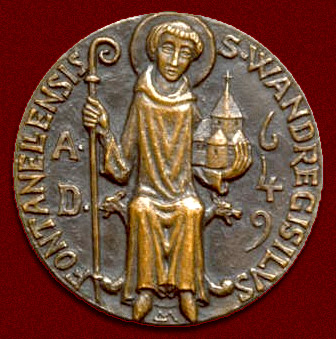
The Life of Saint Vandregizil of Fontenelle (+668)

At the royal court

Reverend Vandregizil
Once upon a time there lived a man named Vandregizil, also known as Vandon, whose life was illuminated by divine light. He was born in the region of Verdun [4] and, of noble birth, further ennobled himself by his monastic life. Until his youth, he lived with his parents, who provided him with the education appropriate for his time, and then assigned him to an important and high service. During these years, Vandregizil, although leading the life of an honorable secular man, always fulfilling all entrusted to him with impeccability, strove in his soul to follow the commandments of Christ, so that the ascetic applied to himself the words of Christ from the Gospel: "Render therefore unto Caesar the things that are Caesar's, and unto God the things that are God's" (Matthew 22:21) [5] .

Vandregisil was still a young man when his parents decided to marry him. Obedient to his parents' wishes, he became engaged to a girl from a good family, whose ancestors were quite distinguished. This was one of the most distinguished families. But Vandregisil was deeply troubled. He longed to leave the world and serve only the Lord, but he feared that his fiancée, even knowing this, would not consent to the dissolution of their engagement. Therefore, Vandregisil decided to marry her first and only then discuss monastic life. And so, having contracted the marriage union with this girl, he, thinking of her welfare and fulfilling the Gospel commandment to love thy neighbor as thyself (see Matthew 19:19), began diligently explaining to her the teachings of the Church, which he knew very well. He especially emphasized the great reward that awaits those who, being one flesh on earth (cf. Matthew 19:5), lead a virtuous life in a monastic manner, desiring unity in heavenly glory with the saints in Paradise. And one day, enlightened by the Holy Spirit, she interrupted him and cried out: “O my lord! Who hindered you from telling me this sooner? I assure you that I will unhesitatingly dedicate myself to the service of the Lord, leaving behind the vanity of this world to labor for the acquisition of the glorious Kingdom of Christ. I have only one request of you, my lord! And this is it: may this intention be fulfilled as soon as possible—to subject us both, you and me, your faithful spouse, to the glorious yoke of Christ.” Hearing this, Vandregizil was filled with joy and thanked the Lord for the greatness of this calling. And so, by mutual consent, they decided to part. Vandregisil himself performed the tonsure [6] and placed the crown of glory on the head of his spouse. And we mention here that the purity of her life and heart was such that the Lord, even during her lifetime, rewarded her with the gift of performing numerous miracles [7] .

Now, looking back, let's return to the time when Vandregisil first experienced the power of God—it happened when he was still a layman. Once, while traveling, Vandregisil, accompanied by his wife and a large retinue, stopped for the night in a place inhabited by people so unkind and dark-hearted that they feared neither God nor their master. A dispute over pasture for horses nearly led to a fierce fight, and many casualties could not have been avoided if not for the divine righteousness and virtue of the man of God. Needing protection, the most effective, the saint armed himself with prayer to God instead of a sword and protected himself with His mercy instead of a shield. The Lord, who loves to respond to the prayers of His faithful servants, came to the rescue—and the quarrel suddenly ceased. The adversaries came to an agreement and became friends. Thus, the son of peace became an instrument in God's hands for reconciling rivals. This event further increased Vandregizil's zeal, and he henceforth loved to repeat these words: "Is He not worthy of being loved more than anything else in the world - Him, God, Who immediately appears where they sincerely call upon Him, as He promised: "When you seek Me with all your heart, you will find Me"?"

Life of Saint Joseph the Hesychast (+1959)


Elder Joseph, known in the world as Francis Kottis, was born in Lefkes on the island of Paros on the 12th of February 1897. His parents, George and Maria, were ordinary but righteous people. He was destined even from his mother’s womb to follow in the footsteps of Christ and become His aide in the deliverance of men. When his mother gave birth to him, she had a vision where an angel was trying to take the baby away from her. When she protested, the angel showed her a note in which it was written that he must take the baby away.

+ On Overcoming Human Limitations


Written by Archimandrite Tikhon Nevidimov


"Human nature is corrupted, and man alone cannot be saved. But in Christ we find all things, if only we deny ourselves and follow Him."
— Saint Seraphim (Rose) of Platina
+
Modern man is captivated by his mind, bound to his body, limited by his time. He builds worlds within himself, prides himself on his achievements, convinced that with the help of science, philosophy, or even religious practices, he can comprehend the truth and overcome himself. But the Holy Fathers tell us that without God, man is only a shadow of what he was created to be. Human limitation is not simply a weakness, not simply an imperfection, but a deep wound, a gap between what God intended for him and what he became after the Fall.
Man himself, without realizing it, falls into the trap of his limitations. He believes he is free, that he thinks, creates, and seeks truth, but in reality, he is bound by his own mind, in the prison of his own ego. Like a child who has never seen the light and believes the world is only a dark room, so a person living without God does not understand how blind he is. His mind is limited by logic, and logic is limited by the boundaries of the created world. His heart is filled with passions, and he is unable to sense the presence of God. Even his will is weakened, for he cannot completely deny himself for the sake of God.

Saint Gregory of Nyssa says that the human mind is like a vessel: it will only contain what it is capable of, and if the vessel is closed, no light will penetrate.
But how can this state be overcome? Modern man seeks quick solutions. He is accustomed to comfort, convenience, and instant gratification of his desires. He wants to transform even spiritual life into a methodology, a technique, an algorithm. He thinks, "If I read so many prayers, if I observe such and such rules, if I learn all the dogmas, then I will become spiritual." But this is a lie. God reveals himself not to those who have "mastered the method," but to those who have completely crushed themselves for His sake.

The Holy Fathers say that the path to God is the path of renunciation. St. Simeon the New Theologian writes that anyone who wants to see the light of Christ must "die to this world." Not physically, but in their heart—stop seeking consolation in things, people, and ideas. Stop relying on themselves, stop believing in their own strength, stop thinking they can achieve anything on their own. Only then will true transformation begin.

But the enemy will not leave such a person alone. As soon as they begin to seek God, Satan will offer them deception—a false sense of spirituality, delusion. Some will see dreams and think they are revelations. Some will feel joy and believe they are already holy. Others will seek mystical sensations, searching for God where He is not. Saint Ignatius Brianchaninov warns: "Satan knows how to imitate the light." The true spiritual path is not ecstasy, not visions, not special experiences, but the cross. It is pain, humility, a constant struggle with oneself.

The most terrible mistake is to fall into despair. When a person realizes their limitations, they may think salvation is impossible. They see that their heart is full of sins, that their prayer is cold, that their thoughts are impure. And they think: "I will never become a saint; I am too fallen, too weak, too insignificant." This is temptation. Saint Silouan the Athonite says: "Keep your mind in hell and do not despair." One must recognize one's own insignificance, but not lose heart, for God is merciful.

How can we navigate this path? How can we overcome our limitations? The Holy Fathers left us three keys: humility, repentance, and prayer. Humility is the realization that without God, we are nothing. Repentance is not just confession, but a constant transformation of ourselves, the mortification of the old man. Prayer is a connection with God, without which we are dead. Without these three things, there is no spiritual life.
But the most important thing is love. Not the love the world talks about, not a romantic feeling, not sentimentality, but sacrifice. To love God means to give ourselves to Him completely. To love one's neighbor means to forgive, to endure, not to judge, to be ready to give everything for him.

Saint John of Kronstadt says: "Without love, man is as sounding brass."

Human limitations are terrible. But God came into this world to break these boundaries. Christ became Man so that man could become god (theosis). It is possible. But only for those who are willing to deny themselves, take up their cross, and follow Him.
"With man it is impossible, but not with God: for with God all things are possible" (Mark 10:27).

Source: https://www.facebook.com/permalink.php?story_fbid=pfbid02HC3RjeZwju2s2FK6iFyviGGFeggkT9FHwLbjkY4GASm51yUf6MMWvXPiVVZuDdGXl&id=100009265523383

Life of Saint Basil the Blessed (+1557)☦️


Blessed Saint Vasilii (Basil), Moscow Wonderworker, was born in December 1468 on the portico of the Elokhovsk church in honour of the Vladimir Icon of the Most Holy Mother of God, outside Moscow. His parents were common folk and sent their son for training in the cobbler's (shoemaker's) craft. During the time of teaching his apprentice the master happened to be a witness to a certain remarkable occurrence, wherein he perceived, that his student was no ordinary man. A certain merchant had brought grain to Moscow on a barge and then went to order boots, specifying to make them such and so, since he would not pick them up for a year. Blessed Vasilii uttered weeping: "I would thee leave them such, since thou will not wear them out". To the perplexed questioning of the master the apprentice explained, that the man making the order would not put on the boots, but rather would soon be dead. After several days the prediction came true.

      At age 16 the saint arrived in Moscow and began the thorny exploit of foolishness. In the burning Summer hear and in the crisp harsh frost he walked about bare-legged and bare-foot through the streets of Moscow. His actions were strange: here he would upset a stand with kalachi, and there he would spill a jug with kvas. Angry merchants throttled the blessed saint, but he took the beatings with joy and he thanked God for them. But then it was discovered, that the kalachi were poorly cooked, the kvas was badly prepared. The reputation of Blessed Vasilii quickly grew: in him they perceived a fool, a man of God, a denouncer of wrong.

The Life of the Holy Great Martyr Panteleimon (+305)


When the impious Maximian reigned, a cruel tormentor of Christians, and when almost the entire universe was covered with the darkness of idolatrous impiety, a great persecution was raised against believers in Christ everywhere, and many confessors of the most holy name of Jesus Christ died as martyrs. Then the holy great martyr Panteleimon suffered for Christ in the Bithynia region in the city of Nicomedia.

The Three Sorrowful Epistles of Saint Philaret of New York against ecumenism


The First Sorrowful Epistle


The Holy Fathers and Doctors of the Church have exhorted us to keep the Truth of Orthodoxy as the apple of our eye. And Our Lord Jesus Christ, teaching His Disciples to maintain every jot and title of the Divine Law intact said, "Whosoever therefore shall break one of these least commandments, and shall teach men so, he shall be called the least in the kingdom of heaven" (Matt. v. 19). He sent His disciples to teach the doctrines He gave them to all nations in a pure and unadulterated form, and that duty then devolved upon each of us Bishops, as the successors to the Apostles. We are also taught to do this by the dogmatic definition of the Seventh Ecumenical Council, which says: "We keep unchanged all the ecclesiastical traditions handed down to us, whether in writing or by word of mouth." And the Holy Fathers of that Council added, in their first Canon: "The pattern for those who have received the sacerdotal dignity is found in the testimonies and instructions laid down in the canonical constitutions, which we receiving with a glad mind sing unto the Lord God in the words of the God-inspired David, saying: 'I have had as great delight in the way of Thy testimonies as in all manner of riches.' 'Thou hast commanded righteousness as Thy testimonies for ever.' 'Grant me understanding and I shall live.' Now if the word of prophecy bids us keep the testimonies of God forever and to live by them, it is evident that they must abide unshaken and without change."

The Church of Christ and the Contemporary Unity Movement in Christianity (Archpriest Mikhail Pomazansky)


It should not surprise us that in our time a search for paths to unification has awakened within fragmented Christianity. Before our eyes is an open and direct campaign against Christianity in communist countries; but in a more outwardly mild form, this campaign against Christianity has also engulfed the countries of the so-called free world. A struggle lies ahead, and it demands the unity of people faithful to Christ and a firm stand in the truth. Enemies are already ready to bury Christianity. In vain! The Lord's words have been spoken: " Be of good cheer! I have overcome the world ." They must be inscribed in our hearts in letters of fire. But the struggle ahead will be long and severe. And who—a believer—will not regret that in these terrible historical hours such masses of Christians remain behind the walls of the Church created by the Lord? Who—a believer—would not rejoice at the unification of all Christianity, scattered and dispersed, in one holy, catholic, apostolic Church?


But terrible temptations lurk if the loudest, most outwardly strong unification process goes down a deceptive path, and especially if it, going in the wrong direction itself, even partially affects our holy Orthodoxy.


And Protestantism has declared itself the initiator of the unification movement in our days.


What caused this movement there? The motives were not of the same kind, but different in different people.


It is natural to think that one of the reasons, good and justified by life, is already indicated, namely: the demand of the time to prepare for the self-defense of Christianity.


Another motive can also be discerned. At the heart of many Protestants' aspirations lies a search for the long-lost, one, one, apostolic Church of Christ. After four hundred years of fragmentation, Protestantism has reached a dead end. In America alone, there are more than two hundred and fifty sects; the time has come for a reverse flow, not away from the center, but toward the sought-after center.


But there is another reason, not stated directly, but making itself felt: the extreme weakening of faith in modern Protestantism. While the Protestant lower classes still live partly by simple faith, theological faculties have become the purveyors of positivism in biblical and church-historical science, a method alien to talk of miracles and the supernatural element in history, and have made religion the subject of "objective science." The leaders and leaders of Protestantism, alumni of these faculties, waver between faith and unbelief in the fundamental truths of the Gospel, which they sometimes openly declare: in the Divinity of the Lord Jesus Christ, in His Resurrection, and others; Faith in the immortality of the soul is fading, and interest in questions of eternal life is fading in Protestantism. And among the impulses for unification, there is a subconscious search for a healing source for the renewal of faith, similar to the renewal of physical organisms through blood transfusion.


However , if you look from the outside, you can’t help but immediately see a number of false premises in these searches.

The Life of Saint Elijah, the God-Seer and Glorious Zealot for God


As we begin to recount the life of Saint Elijah, the God-Seer and glorious zealot for God, the rebuker of lawless kings, the chastiser of those who fell away from God, the punisher of false prophets, the wondrous miracle-worker to whom the elements obeyed and whom heaven itself heeded, the great favorite of God who remains in the flesh even to this day and is destined to come to earth before the second coming of Christ—for a clearer and stronger demonstration of the zeal with which he contended for the Lord God—we shall first briefly set forth the events that took place before him.

A Protest to Patriarch Athenagoras on the Lifting of the Anathemas of 1054 (Saint Philaret of New York)


Your Holiness,


We have inherited a legacy from the Holy Fathers that everything in the Church should be done in a legal way, unanimously, and conforming to ancient Traditions. If any of the bishops and even primates of one of the autocephalous churches does something which is not in agreement with the teaching of the whole Church, every member of the Church may protest against it. The 15th Canon of the First and Second Council of Constantinople of the year 861 describes as "worthy to enjoy the honour which befits them among Orthodox Christians" those bishops and clergymen who secede from communion even with their patriarch if he publicly preaches heresy and openly teaches it in church. In that way we are all guardians of the truth of the Church, which was always protected through the care that nothing of general importance for the Church would be done without the consent of all.

Letter of Blessed Elder Philotheos Zervakos of Paros written to Patriarch Athenagoras in 1968 regarding his heretical stance on ecumenism and dialogue with the catholics/papists


FROM SOME TIME PAST I had purposed to write to Your All Holiness because of Your hasty and unhesitating dealing toward a union of the Orthodox Eastern Church with the evil-doctrined Papacy.


I did not write to You, because illustrious hierarchs, elect clerics, most pious professors and theologians, virtuous monks, learned, informed laymen have written clearly against this false union pursued in so hasty and servile a manner. [1]

Without Orthodoxy the Ecumenical Throne is Useless (Archimandrite Epiphanios Theodoropoulos)


An open letter written in 1965 by Archimandrite Epiphanios Theodoropoulos to Patriarch Athenagoras of Constantinople, criticizing ecumenical overtures to Rome and defending Orthodox tradition. Originally published in 'The Three Hierarchs' and later in 'The Orthodox Word' by St. Seraphim and Herman of Platina.


“Your All-Holiness: For some years now the body of the Orthodox Church, the consciously religious body, stands as an anxious spectator before the Faith-endangering acrobatics of the First Bishop of Orthodoxy. In short, in order that we might avoid another kind of acrobatics, the behavior of you and some of your representatives toward the Pope and Papism casts the truly Orthodox children of the Church not only into unspeakable sorrow, but also into terrible spiritual trial.

You correspond with the Pope on every ecclesiastical matter as if we lived in the fifth century after Christ. You subject yourself to the distresses of long journeys to meet him. You exchange with him tender embraces and brotherly kisses. You call him “First Bishop of Christendom,” and yourself the second. You proclaim urbi et orbi that “no difference separates the two Churches.” You pray with his representatives and conduct yourself toward them almost as you do toward Orthodox bishops.